(Disclaimer: AI was not used in any way in the planning, writing, or editing of this blog post)

On June 26, the Australian Education Research Organisation (AERO) released a collection of new resources for the teaching of writing. This included a writing instuction model (see here), three short courses on understanding sentence structure and grammar, understanding writing needs in your school, and embedding effective writing assessment practices, a practice guide on writing paragraphs, and a practice resource on leading writing instruction in schools. Importantly, the resources are free to access, including the short courses, and it’s all designed with teachers and school leaders in mind.
The release conveys some clear messages about what AERO thinks are priorities in the teaching of writing. While I think there are some obvious gaps that the AERO team is quite likely to fill in the future, as a sudden release of practical, evidence-informed resources, the team who produced them and the teachers who have helped trial and refine them should be congratulated. I hope the teaching community embraces this opportunity to foster effective writing at the whole school, classroom, and individual student levels.
In this post, I summarise five aspects of the release that I found particularly wonderful, and I finish with some aspects that I hope are developed further in the days and weeks ahead.
1. Giving this amount of attention to writing is wonderful
It’s well-known in the education research world that writing has received far less attention than reading (e.g., Graham, 2020; Weekes & Jones, 2021). Perhaps relatedly, most of the recent changes in school literacy have related to reading instruction. Of course, we need to continue focusing on and improving reading, but equally important is how we think about and teach writing. Effective writing instruction is critical at a time when AI is (deep breath) threatening the future of writing development and collective human thought.
AERO’s resources aim to foster understandings about writing that can be shared by all teachers at the same school. Whole school approaches for the teaching of reading seem to be working well; it’s time we achieved the same in writing, and given the wide variety of distinct approaches to teaching writing and the relative lack of compelling evidence to support popular approaches, AERO’s release may be just what we need to make this happen.
2. Emphasising and supporting writing beyond the English classroom is wonderful
Perhaps the main message in AERO’s release (and the surrounding media coverage) has been the importance of fostering writing skills in every teaching area/subject. There is a secondary school flavour to these resources, and this makes sense when primary school teachers can’t avoid teaching writing across the teaching areas (in the areas they teach, at least).
I can think of a predictable kneejerk reaction to the idea that every secondary teacher should be an expert teacher of writing. This is the obvious though problematic thought that writing instruction is the work of the English teacher, and that since other teachers already have so many things to be teaching, they don’t have time to do the English teacher’s job as well. There is truth to the idea that teachers are overwhelmed with things to do and teach, but as I’ve argued to preservice teachers for more than a decade, writing (i.e., communicating understandings and thoughts through written words) is fundamental to teaching and learning in every area.
There are genres of writing that are only important in teaching areas outside English, and there’s almost no chance that English teachers are preparing students to write those genres. If science teachers and geography teachers and psychology teachers and all the other kinds of teachers don’t teach students to write in the ways that matter in their specific subjects, what and how the students write in these subjects is unlikely to be very impressive. It would be unreasonable to expect students to write in the ways that matter in a given subject without them having clear instructions on how to achieve this. Writing is fundamental to teaching and learning, so it’s great to see the emphasis on building teacher knowledge about language and genre collectively.
Now, of course, there are many teachers in teaching areas other than English that already teach students to write, but I think what the AERO materials do well is promote a future where every teacher is at least familiar with the same basic metalanguage for writing – that is, the same basic language for talking about our writing choices. We don’t want to give students mixed messages about aspects of writing when learning to write is already so challenging for many of them. While I think we need to add more to AERO’s resources over time so that we are teaching the richness of written language needed to communicate in all prominent school-based contexts, the push for this to be something every teacher can own and share and develop together is exactly what we need.
3. Supporting schools to go deeper when unpacking and using NAPLAN results is wonderful
Sad as it sounds, I’ve been researching NAPLAN-related topics for my whole academic career – in fact, my PhD was about understanding the writing choices of students who scored highest on the 2011 NAPLAN writing test (in the same PhD I critiqued the persuasive writing test for several of its issues). Over the years, I’ve taken an interest in asking practising teachers and school leaders how they make use of NAPLAN, and their responses have never been particularly positive. Many schools have NAPLAN scores baked into their school improvement plans, and they do generally consider broad patterns in NAPLAN results (e.g., “We’re down a bit in spelling this year. Let’s do some spelling PD”). But given our country’s immense investment in NAPLAN each year, it’s surprising that we don’t get more out of it for our students.
From the start, NAPLAN has had two key aims: First, to drive school improvement; and second, to increase the accountability of our education systems. Even the most ardent NAPLAN hater must admit that it has achieved its second aim. Essentially everyone in Australia knows what NAPLAN is, and the media makes sure we all hear about what’s happening in NAPLAN results at least a couple of times each year. NAPLAN is definitely used as a political tool and as both a stick and a carrot for schools, but it’s not really used to enhance the education we offer our students in a compelling way. Despite the stated aim for driving school improvement, this is just not what it’s been used for until now (generally speaking – for a great article that shares how certain schools get value from NAPLAN, see Jackson, 2022).
Having a clear focus on how school leaders and teachers can think about and use NAPLAN results to improve writing instruction and student writing outcomes is a great aspect of the AERO release. Fewer people will have issues with NAPLAN if it can be used to meaningfully improve educational outcomes for learners, and this treatment of NAPLAN by AERO suggests some new directions that, in my opinion, are worth a try. In my writing about NAPLAN, my intention has always been for us to make the annual tests as good as they can be, informing where we prioritise interventions and improving learning, but without NAPLAN overstepping its welcome in classrooms. It will be good to hear how schools go with the suggestions AERO is making here.
4. The resources AERO has included in the release are wonderful
I’ve given it a couple of days of thought, and while I’d still like to dig a bit deeper with AERO’s writing instruction model, on the whole, I think it’s a great first attempt.
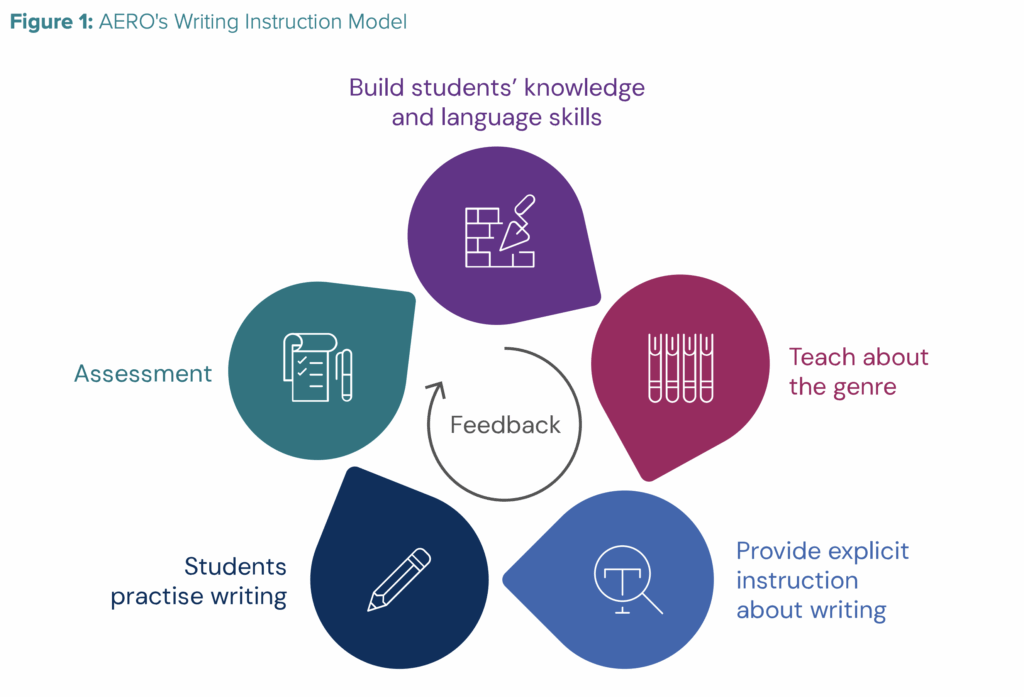
As a fan of genre-based pedagogy as an approach for teaching writing, and someone who’s promoted the similar teaching learning cycle as an instructional model for writing in my work with preservice teachers, my approval of AERO’s model is perhaps unsurprising when they state that it’s based on established evidence from the field of applied linguistics (AERO cites Callaghan & Rothery, 1988; Derewianka, 2020; and Humphrey & Feez, 2016 – all key promoters of the teaching learning cycle). It’s great to have a clear emphasis on explicit instruction and on the need to get down to the nuts and bolts of written texts (i.e., the language and genre features).
While all of what’s included is, in my view, necessary and exciting, I do feel like there’s some room for maybe another petal in the model focusing on the more mechanical aspects of writing, like handwriting, keyboarding, and spelling. The team at AERO might argue that these aspects are part of the language skills covered in the first petal? But even without the mechanics, what’s included lines up well with what we know about effective writing instruction as summarised in AERO’s own writing instruction literature review.
Beyond the model itself, I had fun completing the short courses (yep, I’m a nerd). The sentence structure and grammar course teaches ideas that are commonly taught to preservice teachers in many/most Australian universities. They certainly get this with me at UQ, though I like to include both traditional and functional grammar terms (e.g., noun groups and participants) because I’ve found the functional terms offer great assistance to students who are less familiar with traditional grammar (since they are based on meaning). AERO promotes a functional model of language as underpinning all their writing work, so it’s interesting that they haven’t used more of the functional grammar terminology. I think this is all possibly OK though if you treat traditional grammar terms in functional ways (which kind of smuggles in functional grammar without referring to it – a bit like how the Australian Curriculum: English works). This functional approach (arguably) sets our treatment of language/grammar/sentence structure in Australia apart from other countries including the US and UK. It’s quite a big thing that the AERO team has taken a functional approach and it ensures that their offerings are compatible with the treatment of language in the Australian Curriculum: English.
The inclusion of a practice resource for leading writing instruction in schools also shows the thoughtfulness of AERO’s approach. Taken together, this release of materials is clearly intended to be grappled with by teams in schools, not just by individual teachers. This can only increase the impact and sustainability of the work.
5. The lack of focus on AI and writing is wonderful
I’ll keep this section short and sweet! Nothing threatens the future of writing development for students and teachers more than AI. I will leave it to others to argue for the obvious efficiency gains and novel new methods of “writing” together with AI. I’ve decided to take the position that we should fight against the integration of AI in our classrooms for the sake of our students’ thinking and writing development. If people want to use AI as adults, they should go for it. But since the human brain continues developing well after students finish school, giving students access to a technology that so easily supplants the need to learn to struggle productively with writing is, to me, a bad move. This is new technology, but there’s increasing evidence that supports my view (e.g., check out the latest studies that have shown heavy AI use massively limits brain activity and problem-solving capacity, or that AI use is making us all think, speak, and write exactly like AI).
I will admit it’s early days with AI; much research could come out in support of AI and writing, and even if AI smashes a person’s ability to write and think, perhaps our future is one where thinking and writing are unimportant (as horrible as that should sound to every teacher).
Anyway, kudos to AERO for sticking with the writing basics!
6. The potential for more is wonderful
I hope this is just the beginning of AERO’s writing release. The materials provided are wonderful in the ways I’ve outlined, and as we move forward, in addition to adding more on writing mechanics, I feel we also need more of an emphasis on the existing genre petal of the model. I did some work with the Department for Education South Australia in the past few years, and they have developed the most amazing genre scopes and sequences, mapping out the important school-based genres that are typically taught in all teaching areas of primary and secondary school, with plenty of suggested discipline-specific topics to teach those genres, and (importantly) guidance on the structural features of genres that are currently missing in the AERO materials.
In terms of the structure of genres, it’s normal for teachers to teach the key stages that make them up. Less normal is taking the next step to teach about the phases that make up these stages. Let me offer a common primary school example: basic narrative structure includes an orientation stage, a complication stage, a resolution stage, and an (optional) coda stage. These stages are relatively fixed, they are important, and they are useful for students who are first learning to structure narratives. But we can take the next step by also teaching them about the more flexible phases that we use to build these stages. A writer might start a narrative orientation with a character phase (where they introduce the main protagonists). Instead, they might start with a setting phase (where they introduce the setting). They might have a phase in their orientation where they allude to the complication that will be the focus of the next stage. The choices of phases is much more flexible than stages and is a big part of what sets different texts in the same genre apart. If teachers in every teaching area knew the genres of writing that matter in their specific discipline, and knew the stages and phases that authors commonly use when writing these texts (and that are expected by readers), that could definitely improve the situation in schools.
Am I suggesting that genre is completely missing in the AERO materials? No, not exactly. In one of the courses, you eventually come to a point where the sentence-level ideas are distinguished for authors composing imaginative, informative, and persuasive texts (i.e., we learn about sentence-level features that characterise the different text forms). Also, in the paragraph guide, a strong message is conveyed that authors write paragraphs to achieve different purposes, and that if you are explaining or reporting or persuading (or whatever), you will need to change how you write the paragraph.
AERO has seemingly taken a bottom-up approach to genre work. It’s not to say that a bottom-up approach is bad; it’s just different to how genre-based pedagogy often works in classrooms. In genre pedagogy, we often consider the genre first (since this gives you the purpose for writing), and the structural and sentence-level choices are then informed by the purpose (as well as other elements of the context, such as who you are writing for).
But whether a teacher/school wants to go from the bottom-up (i.e., sentences, paragraphs, genre), from the top-bottom (i.e., genre, paragraphs, sentences), or to have a focus on both directions when it makes most sense, we should still hopefully achieve our goals of improved writing outcomes. It’s just important that there aren’t important aspects of writing missing. I do think that giving teachers a clear sense of the genres that matter in each teaching area and the structural features (i.e., stages and phases) that make up those genres is the next obvious piece of the AERO writing instruction puzzle. And if anyone from AERO is reading this, why not reach out to our colleagues at the Department for Education South Australia who have done this exact work recently and effectively?
Let’s all make the chance count
This has become a surprisingly long blog post, so I must have had a lot to say about this release! Overall, we should congratulate the team at AERO and acknowledge that the work has been trialled with teachers and school leaders for at least the last year, so there is some confidence that building teachers’ knowledge of writing in these ways will improve things.
I see a great deal of overlap between what AERO is promoting here and what many/most literacy-focused teacher educators like me already promote in teacher education. This might be in part why Australian teachers felt considerably more prepared by their teaching education to teach writing than teachers in the US, Norway, the Netherlands, Taiwan, and New Zealand (as shown in research by Malpique et al., 2022; Steve Graham and colleagues, and several others).
This might be one of those rare moments where policymakers, researchers, teacher educators, school leaders, teachers, and all education stakeholders can come together to make a difference for our students. Some of us may prefer particular grammar terms over the ones AERO has chosen. Some might want a bigger emphasis on the mechanics of writing or structural features. But it seems like there’s more than enough in common for everyone to get along and push in the same important direction for our students’ sake. This is definitely the right move to make for writing instruction given the undeniable threat posed by AI and the collective (and arguably unique) wisdom we have in Australia on how to teach writing well.
Note: Thanks to Caryn Hellberg (one of my outstanding PhD candidates) who discussed the AERO release with me in the last couple of days. This discussion likely influenced how I’ve thought about the release.
References
Callaghan, M., & Rothery, J. (1988). Teaching factual writing: A genre base approach. Metropolitan East Disadvantaged Schools Program.
Derewianka, B. (2020). Growing into the complexity of mature academic writing. In H. Chen, D. Myhill & H. Lewis (Eds.), Developing writers across the primary and secondary years (pp. 212–236). Routledge
Graham, S. (2020). The sciences of reading and writing must become more fully integrated. Reading Research Quarterly, 55(S1), S35-S44. https://doi.org/10.1002/rrq.332
Humphrey, S., & Feez, S. (2016). Direct instruction fit for purpose: Applying a metalinguistic toolkit to enhance creative writing in the early secondary years. Australian Journal of Language and Literacy, 39, 207–219. https://doi.org/10.1007/BF03651974
Jackson, C. J. (2022). The utility of NAPLAN data: Issues of access, use and expertise for teaching and learning. The Australian Journal of Language and Literacy, 45, 141-157. https://doi.org/10.1007/s44020-022-00009-z
Malpique, A., Valcan, D., Pino-Pasternak, D., & Ledger, S. (2022). Teaching writing in primary education (grades 1– 6) in Australia: A national survey. Reading and Writing. https://doi.org/ 10.1007/s11145-022-10294-2
Weekes, T., & Jones, P. (2021). The challenges of mapping literacy development across the years of schooling. Australian Journal of Language and Literacy, 44(2), 11-25.